
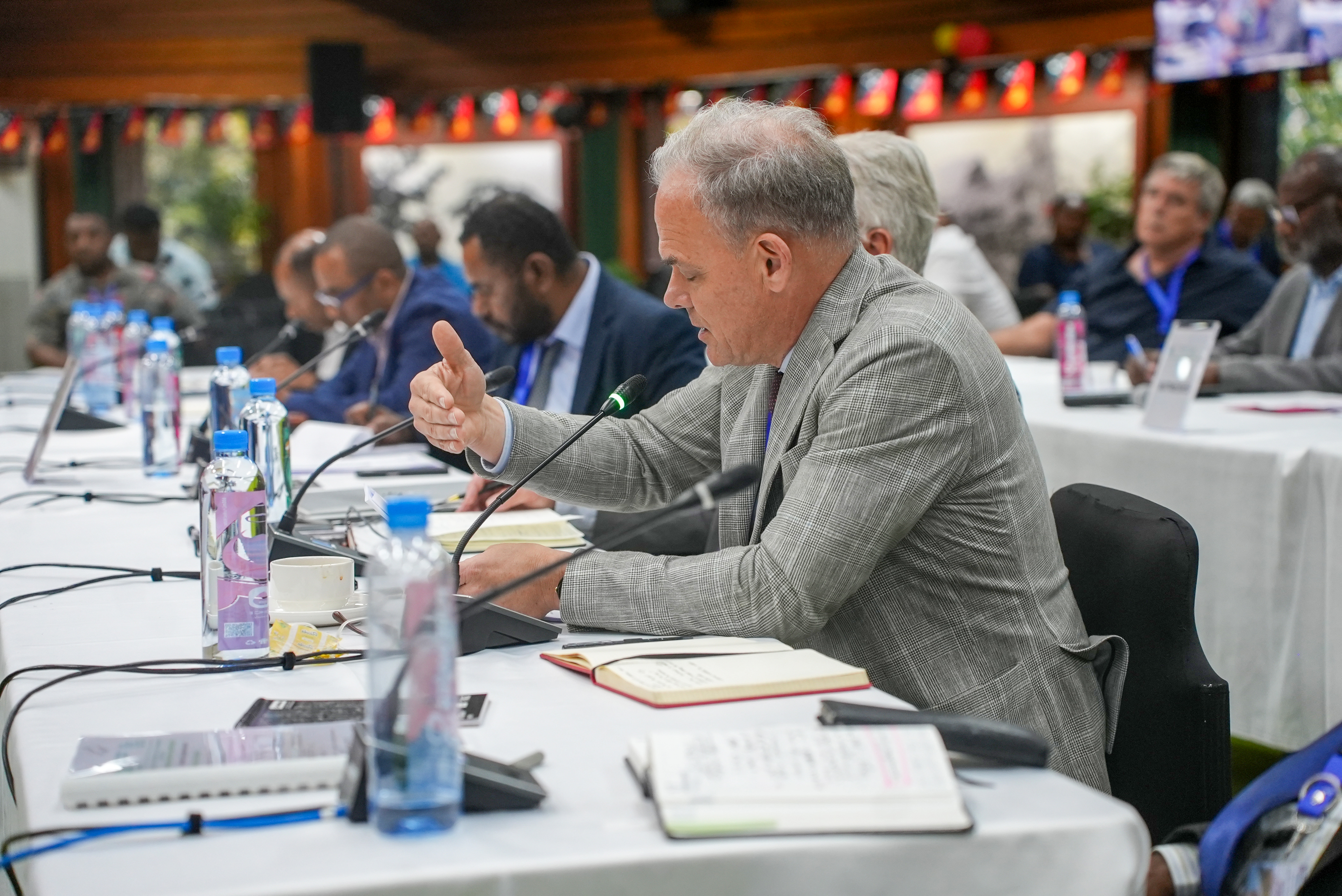
Speaker: Dr. Kevin Telmer, Founder, Artisanal Gold Council, Artisanal Gold Enterprises
Date: Monday, 29th September, 2025 (10-Minute Verbal Submission)
1. Introduction and Expert Credibility
Honorable Chairman Juffa, distinguished members of the Special Parliamentary Committee. Thank you for the invitation to testify today on a matter of critical importance to the future of Papua New Guinea: the systemic destruction of its once world leading alluvial gold sector through smuggling and illegal gold flows.
My name is Dr. Kevin Telmer. For the past three decades, I have dedicated my career to understanding and improving the Artisanal and Small-Scale Gold Mining (ASGM) sector globally. I hold a PhD in Geochemistry and was a tenured professor before founding the Artisanal Gold Council (AGC) in 2008, and Artisanal Gold Enterprises (AGE), a social enterprise in 2019. The mission of my career, and my personal focus, is transforming ASGM into a formalized, responsible, and sustainable sector worldwide, capable of lifting millions out of poverty.
I have worked in over 30 countries across three continents in the field directly with artisanal miners.
I have spent the last four years specifically focused on the PNG’s alluvial gold sector, working with both miners and regulators. I know this sector well. I have done workshops directly in the Bulolo River with miners and you can ask them about the quality of my work and the value I bring.
When I first came to PNG, it was a wonderful surprise as I came to understand that it had one of the world’s most robust and well-managed systems for alluvial mining. It had what many countries did not. It was truly integrated into society, was well regulated, and very well supported by the government including its own governmental division at the MRA – the small scale mining branch – that had quite remarkably, a vision for miners to climb up a professionalization ladder, and to make it concrete, it had its own in the field training centre, the Small Scale Mining Training Centre in Wau. This was securely funded directly through the modest alluvial mining levy.
These were all firsts and world leading systems. I broadcast this success at meetings and to my network with great enthusiasm. It was, truly, a jewel. It is what attracted me to come and work here four years ago.
But now it is under threat!
2. Evidence of a Crisis: The Four Lines of Proof
The data we have compiled leaves no room for doubt: PNG’s gold sector is facing a crisis driven by sophisticated illegal actors. We have found four clear lines of evidence of gold smuggling, which I will present to you now.
Line of Evidence 1: The Impossible Disconnect (Falling Exports vs. Rising Price)
Look at the trend since 2020. The world gold price has surged—up by over 35%. Alluvial mining activity on the ground in PNG has expanded vastly. More miners, more leases, more mechanized operations. Yet, over the same period, legal alluvial gold exports plummeted by a staggering 64%—from approximately 3.6 tonnes down to barely 1.3 tonnes.
This production crash is entirely impossible. The gold is being produced; it simply stopped being legally declared. Our comparison of PNG’s official exports with international import records shows the stark reality: in both 2021 and 2022, over two-thirds of PNG’s alluvial gold was smuggled out of the country.
Line of Evidence 2: The Underdeclaration of Purity
A key mechanism of this smuggling is the deliberate underdeclaration of gold purity. We have tracked one foreign-controlled exporter, who, over several years, declared purities as low 29%. Geologically, this is impossible. The purity of alluvial gold found in PNG ranges from 60 to 90%.
By under-declaring the gold content—claiming that a bar is only 30% pure when it is actually 70%—the illegal actor conceals the remaining 40%. They pay the export levy only on the declared 30%, while the undeclared portion leaves the country tax-free.
And then, they only need to repatriate in USD the declared 30% while the undeclared USD can remain abroad. They are thus illegally transferring money out of PNG.
In one year alone, this scheme potentially concealed over 787 kilograms of gold, worth $145 million Kina. This is gold, and revenue, and foreign currency, stolen from the people of PNG.
Line of Evidence 3: Disguising the Destination of Exported Gold
The export license conditions as mandated by BPNG require that gold be exported to a refiner that can generate certified records of purity and payment for the PNG government but we have discovered that at least one exporter sends the gold to a company that it owns that is not a refiner and that tranships the gold on to another destination in order to conceal these financial flows. This is clear from the export and import records.
Line of Evidence 4: Foreign Investment in a Collapsing Legal Market
The fourth piece of evidence is the correlation between the rapid decline of legal exports and the increasing involvement of foreign-backed investment and mining activity since 2020.
Why would foreign actors rush to invest heavily in a sector whose official export numbers are collapsing? The answer is simple: they are not investing in the legal sector; they are funding the illegal network. They exploit local licenses and use sophisticated networks to facilitate tax evasion, money laundering, and the illegal transfer of hard currency out of PNG.
3. The Destruction Caused by Smuggling
The consequences of this smuggling are devastating, both for the nation and for the hard-working alluvial miners.
At a high level, this compromises the economic sovereignty of Papua New Guinea. The illegal financial flows associated with massive undeclared gold exports directly deplete PNG’s hard currency reserves. The lack of effective enforcement undermines PNG’s standing with international bodies like the Financial Action Task Force (FATF). Continued failure to act against these organized illegal financial flows risks tipping PNG into an international grey-listing, which would negatively impact the nation’s banking and foreign exchange capabilities making life more difficult for all.
Most tragically, smuggling is destroying the livelihood of tens of thousands of honest citizens. Legal and illegal gold flows cannot co-exist. The illegal actors – who pay no export levy, no corporate tax, no income tax, and ignore foreign exchange controls – have drastically lower operating costs.
This commercial advantage forces legal, law-abiding gold buyers out of business, systematically replacing them with an entirely black-market economy. When the legal market collapses, other aspects of society break down.
Government agencies, like the MRA, lose the revenue to provide essential services, training, and claim systems. And alluvial miners, abandoned by government, become increasingly vulnerable to conflict, exploitation, and the predation of criminal syndicates. Hostilities between government and miners increase.
On an environmental basis the alluvial gold mining sector is on a terrible trajectory. It is headed towards what is apparent in several African countries like Ghana, where environmental abuses involving massive amounts of toxoic substances mercury and cyanide are emitted into the environment and never cleaned up, poisoning people and food for generations.
It wasn’t like this just a few years ago and this is an unnecessary tragedy.
4. Solutions: Clear, Enforceable Steps
Fortunately, PNG is an island nation with relatively few international exit points. You are in a better position than many other countries to fix this. I propose three clear, enforceable solutions:
- Eliminate Bad Actors and Strengthen Licensing: Review and revoke the licenses of exporters demonstrating impossible gold purities, using non-independent “refiners,” and transshipping gold to undeclared destinations like Singapore via Hong Kong. The Bank of PNG can demand that gold be exported only legitimate actors that deliver to refineries accredited by recognized international bodies like the LBMA and DMCC.
- Control the Airports: Gold travels by air. PNG can implement technical monitoring personnel and equipment at Jackson’s International Airport. This includes dedicated X-ray screening of outgoing hand luggage for gold, a method that can shut down hand-carry smuggling instantly. The weight and purity of all declared shipments must be verified before they leave.
- Install a Special Gold Export Unit: Create a small, specialized, and dedicated Gold Enforcement Unit attached to Customs. This unit’s sole focus would be intelligence gathering, monitoring airfreight, and scrutinizing export documentation for the specific, fraud methods we have uncovered.
5. Summary and Conclusion
Honorable members of the Special Parliamentary Committee, let me conclude with this: PNG’s alluvial gold sector is a perfect engine for upward mobility. It is a natural, decentralized system that puts wealth directly into the pockets of your rural people, allowing them to educate their children, build businesses, and move toward a better life.
It is a resource that is currently being stolen on a massive, industrial scale, and this theft is destroying the capacity of the sector to empower your citizens.
The systems and laws to fix this problem are largely in place. What is required now is political leadership and decisive enforcement. You have the opportunity, right now, to send an unmistakable message: PNG is no longer open for illegal business. I encourage you to act swiftly to restore the integrity of this vital industry for the benefit of all Papua New Guineans.



Leave a Reply