
The Special Parliamentary Committee on Pubic Sector Reform and Service Delivery commends the National Airports Corporation Security Division, Papua New Guinea Customs Service, Royal Papua New Guinea Constabulary, Immigration and Citizenship Authority, and all officers involved in the recent operation at Jacksons International Airport that reportedly disrupted an alleged gold smuggling operation destined for Hong Kong.
The operation demonstrates the professionalism, vigilance, and integrity of the officers involved and highlights the importance of effective cooperation between agencies responsible for protecting Papua New Guinea’s borders and national interests.
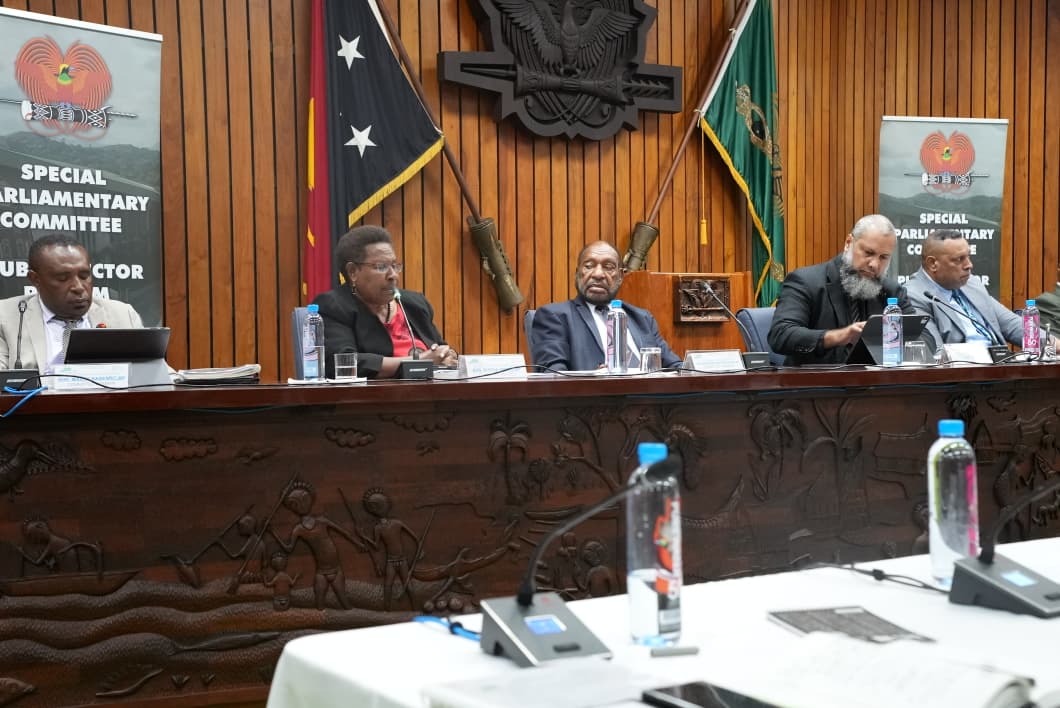
The Chairman of the Special Parliamentary Committee on Public Sector Reform and Service Delivery, the Hon Gary Juffa , noted that this successful interception comes only months after the Committee November 2025 hearings exposed gold smuggling, illicit financial flows, border security vulnerabilities, revenue leakage, and transnational organised crime such as the interceptions of 8, 9 and 10 April 2026.
During those hearings, the Committee heard evidence from agencies responsible for border management, customs enforcement, law enforcement, aviation security, immigration, mining regulation, and revenue collection. Serious concerns were raised regarding weaknesses in border controls, enforcement capability, intelligence-sharing arrangements, and the growing sophistication of transnational criminal networks seeking to exploit vulnerabilities within PNG’s systems.
The recent operation is encouraging and suggests that agencies have taken positive steps to strengthen vigilance, coordination, intelligence gathering, and enforcement activities. Those efforts deserve recognition.
However, while this success should be welcomed, it must not lead to complacency.
The recent placement of Papua New Guinea on the Financial Action Task Force (FATF) Grey List is a stark reminder that significant challenges remain. While the efforts of frontline officers are commendable, the Grey Listing highlights deficiencies within national systems designed to prevent money laundering, combat illicit financial flows, and address organised criminal activity.
It serves as an international warning that more work is required to strengthen institutional capacity, improve inter-agency cooperation, enhance intelligence and enforcement capabilities, and ensure that our laws and systems are capable of effectively confronting increasingly sophisticated transnational criminal enterprises.
This interception demonstrates progress. It does not mean the problem has been solved.
Criminal syndicates involved in gold smuggling, money laundering, drug trafficking, human trafficking, illegal firearms movements, wildlife crime, environmental crime and other forms of organised criminal activity are adaptive, well-resourced, and persistent. They continuously seek opportunities to exploit weaknesses within border management systems and public institutions.
For this reason, enforcement efforts must be continuous, consistent, intelligence-driven, and adequately resourced.
The Chairman also expressed alarm at the reports which indicate that international flight management appeared to be severely compromised if the gold could be smuggled into the Aircraft before passenger embarkation in the aircraft’s pillows and other passenger comfort facilities. He reminded authorities that under provisions of the PNG Customs Act, in particular Section 145 the aircraft used in smuggling can be seized.
“The level of confidence foreigners display in going through the metal detectors with gold soaked in their apparel did not just appear overnight. There must exist a high level of collusion. If citizens face severe jail terms for fare less value of financial crimes, why should foreigners and their facilitators also not be prosecuted and face jail time here in PNG?,” Mr Juffa added.
The Committee heard in November 2025 that the value of smuggled gold was in the vicinity of K1.5 Billion per annum over many years. The recent heists now indicate a much higher figure of national wealth being stolen.
The Committee therefore intends to conduct two further hearings on border security and transnational crime preparedness .
These hearings will assess:
- Operational readiness of border agencies;
- Existing border security protocols;
- Intelligence-sharing mechanisms;
- Technology and surveillance capabilities;
- Staffing and resource requirements;
- Legislative and policy gaps;
- Preparedness to combat emerging transnational criminal threats; and
- Papua New Guinea’s readiness to meet international standards following the FATF Grey Listing.
- What PNG is forfeiting to foreigners illegal self enrichment, leaving behind the negative social, environmental and economic consequences.
The Committee views the FATF Grey Listing as a matter of national concern. Our forthcoming hearings will examine whether agencies possess the legal powers, resources, systems, technology, intelligence capabilities, and accountability mechanisms necessary to effectively protect Papua New Guinea’s borders and national interests.
I once again commend all officers involved in this operation. Their actions demonstrate that when agencies work together with professionalism, integrity, and determination, significant threats to our nation can be detected and disrupted.
The Committee remains committed to ensuring that all relevant agencies are properly equipped and supported to safeguard Papua New Guinea’s borders, protect national revenue, combat transnational crime, and uphold public confidence in our institutions.
Protecting Papua New Guinea’s borders and natural resources is not merely a law enforcement responsibility. It is a matter of national security, economic security, and public trust.
Hon. Gary Juffa, MP
Governor, Oro Province
Chairman
Special Parliamentary Committee on Public Sector Reform and Service Delivery
Leave a Reply