
Theme: What Papua New Guinea can no longer see about its own log exports, and what this network can do about it
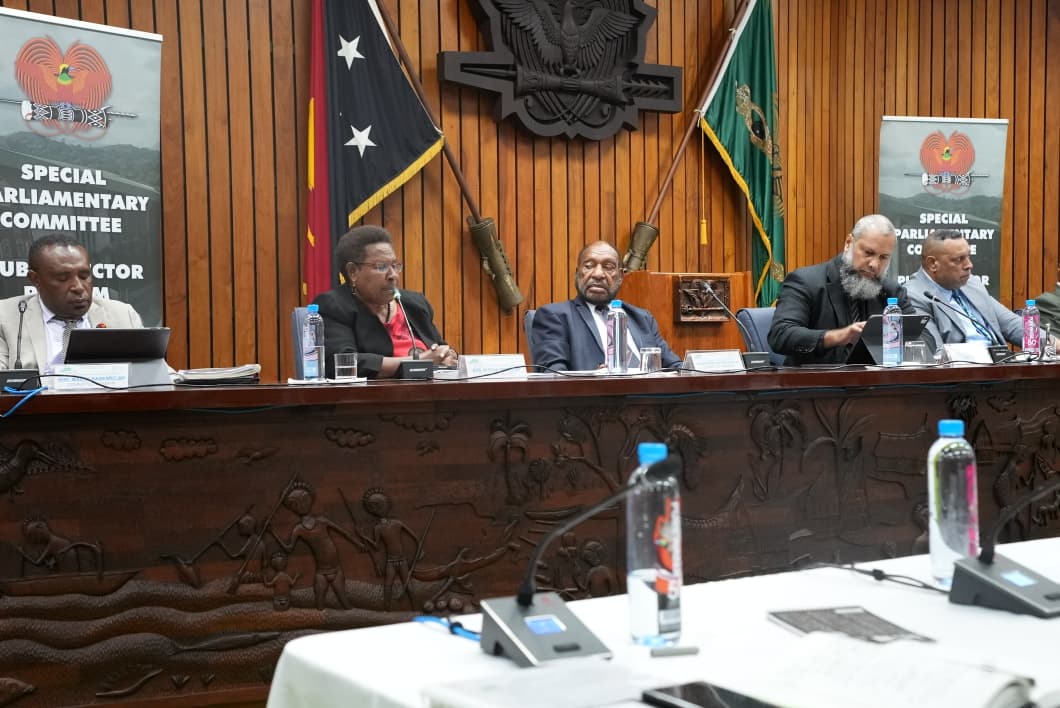
Address by the Honorable Gary Juffa, MP, Governor of Oro Province and Chairman of the Special Parliamentary Committee on Public Sector Reform and Service Delivery

Opening
Good morning Chairperson and members of the Asia Pacific Forest Crime Network, colleagues from Papua New Guinea and the Solomon Islands, friends from the universities, from civil society, from the regulators and the enforcement agencies.
Thank you for having me. I am conscious that this is the third meeting of a network that has spent two years building a serious body of knowledge about forest crime in our region, and that many of you know the financial flows behind Papua New Guinea’s log trade in more detail than most of our own agencies do. So I am not here to explain forest crime to you. I am here to tell you what a parliamentary committee saw when it opened the books on the State’s own defences, and to ask you to help us with what comes next.
This session is what I call “Understanding the Gaps”. I want to talk about the biggest gap of all: for more than thirty months, Papua New Guinea has not been able to see its own log exports. I will summarise my Committee’ latest report in two minutes, then take you through four things it exposes, and then I will put a concrete proposal to you for the sessions that follow. I leave 10 hard copies of our report in this conference and an electronic copy can be sent to anyone upon request by our host.
Part One: The report in two minutes
In 1994 the Barnett Commission of Inquiry exposed transfer pricing, under-declaration and corruption in Papua New Guinea’s logging industry on a scale that shocked the country. The single most important reform to come out of Barnett was independent pre-shipment inspection: every round log leaving our shores would be checked by an independent international firm, for species, for volume and for declared value, before the ship sailed. From July 1994 that firm was SGS. For nearly thirty years SGS was the eyes and ears of the State on every log wharf in the country.
On the twelfth of March 2024 that service stopped. Not because the Government decided we no longer needed it. It stopped because the State had not paid its bills. Arrears of between twelve and a half and fifteen million Kina had built up over about six years, on a contract that cost between six and a half and eight million Kina a year, and that by the evidence before us protected somewhere between five and fifteen percent of the annual value of our log exports. For want of a payment pathway between Treasury and the Forest Authority, we switched off the one mechanism Barnett told us we could not do without.
My Committee held public hearings in May and August 2025 and summoned the Forest Authority, Treasury, Customs and SGS. We found that:
- independent monitoring has ceased and the State has no independent assurance over what leaves the country;
- that in thirty years of documented discrepancies there has not been one prosecution;
- that the Forest Authority’s internal self-inspection is not a credible substitute;
- that the loss of this safeguard exposes Papua New Guinea to grey-listing by the Financial Action Task Force; that the policy to end round log exports and move to downstream processing has been treated with contempt;
- and that customary land rights are being abused through Forest Clearing Authorities issued for agricultural projects that do not exist.
We recommended five things:
- restore independent monitoring immediately with ring-fenced funding;
- commission a forensic audit of log exports back to 2015 with a recovery mandate;
- introduce real penalties and cancel the licences of habitual offenders;
- take permit approvals away from the Minister and put them under the Forest Authority Board with a public register;
- independently review every Forest Clearing Authority and lease for landowner consent and compliance.
The report was tabled in the National Parliament in November 2025 as Report Number Eleven. It is not, as I wrote in the foreword, a set of gentle suggestions. It is a prescription for emergency surgery.
Part Two: Four gaps the report exposes
A report to Parliament has to be measured in its language. This morning I want to be plainer, and I want to frame each of these as what it is: a gap in what the State can see, and therefore a gap in what anyone can act on.
The first gap is the export data itself: into a third year without independent pre-shipment inspection.
When my Committee tabled its report, the unmonitored period stood at eighteen months. Today it is more than thirty. We are into the third year in which not one shipment of round logs from Papua New Guinea has been independently verified before it left the wharf.
In practice that means every log ship is cleared on the word of the exporter, supposedly checked by the same authority that issues the permit, approves the price and collects the levy. No independent species check, so Kwila can sail declared as a low value species. No independent scaling, so the volume is whatever the paperwork says. No independent check of free on board value against world prices, so transfer pricing goes unchallenged. And, critically for this network, the monthly discrepancy reports that once flowed from SGS to Customs and the Internal Revenue Commission stopped the same day. The data your own research depends on, the data a financial intelligence unit depends on, simply ceased to exist.
I want to be fair to the Forest Authority. Its officers told us they would rather have SGS back. Treasury told us the arrears had been paid by the end of 2024. And yet [as I stand here] the inspectors have not returned. That tells you the problem was never really the money. Six and a half million Kina a year is a rounding error against the revenue at stake. The problem is that nobody in the system regarded independent scrutiny of log exports as something that could not be allowed to lapse. It lapsed, and the machinery of government shrugged. Every month it continues, the evidence trail goes colder and the forensic audit we have recommended becomes harder.
The second gap is financial: the inference of money laundering.
I choose the word inference carefully. My Committee has not found that any named company has laundered money through the log trade. That is for investigators, prosecutors and courts, and this afternoon you will hear from the agencies responsible. But I ask you to look at the evidence and draw your own conclusions.
Independent pre-shipment inspection is recognised internationally as an anti-money laundering and counter-terrorist financing safeguard. It certifies that a trade flow is what it claims to be: that the goods exist, that they are what the paperwork says, and that the money crossing the border corresponds to a real transaction at a real price. Remove that certification and you have removed the one point at which the State can say, with confidence, that a shipment of logs is not simply a vehicle for moving value out of the country.
Now look at what the data showed while we still had it. At our hearing we examined one shipment where the export permit signed by the Minister authorised ten cubic metres of Malas. The ship carried two hundred and ninety. A discrepancy of two thousand eight hundred and eighty seven percent. The response of the system was not an investigation. It was to amend the permit after the fact so the paperwork matched the ship. When I asked how a buyer in Singapore or Malaysia who contracted for ten cubic metres came to receive two hundred and ninety, no one could tell me. That was one line, on one page, of one monthly report, in a series that ran for thirty years.
The Forest Authority’s Managing Director also told us that when the anti-money laundering framework was extended to his agency in 2023, some eighty million Kina was removed from forestry accounts. I do not claim to know the full story behind that figure. But it tells you the authorities responsible for financial integrity in Papua New Guinea have already looked at this sector and not liked what they saw. And the Financial Action Task Force does not grey-list countries for what they intend to do; it grey-lists them for the safeguards they fail to keep. A fifteen million Kina unpaid invoice could end up costing my country more than the entire forestry sector earns.
The third gap is in licences and permits: leases that nobody monitors and agreements that nobody enforces.
Fifteen years ago, at this university, scientists and NGOs met and produced the Cairns Declaration on Special Agricultural and Business Leases. They were right then, and the instrument has simply changed its name. Today the Forest Clearing Authority, designed to allow forest to be cleared for genuine agriculture, has become the preferred route for large-scale logging that bypasses the sustainability requirements of the Forestry Act altogether. A company proposes oil palm, or cocoa, or tree farming. It is given a clearing authority over a vast area. It removes every merchantable log. And the agriculture never comes.
I do not need the report to tell me this. I drive past one of these projects in my own province almost every day, on the road to Girua airport. The company claimed tree farming and cocoa. There is not a seedling in the ground. When I put that to the Managing Director of the Forest Authority under oath, he did not dispute it. He told us his own audit of Forest Clearing Authorities across the country would recommend terminating something like sixty five to seventy percent of them.
Sit with that. By the regulator’s own assessment, two out of every three agricultural clearing authorities in Papua New Guinea are logging concessions by another name. Behind every one are landowners who signed, or were said to have signed, on the promise of a school, a road, an aid post or a plantation, and who have watched the trucks leave and nothing arrive. Nobody has been checking those leases against their terms. Nobody has been enforcing the agreements. The recommendations of the SABL Inquiry were never implemented, and the same thing is happening under a different heading. There is no public register that would let a landowner, a journalist or a researcher see which permits exist, on what land, with whose consent, and against what commitments. That is the data gap tomorrow’s sessions on justice for communities will run into, again and again.
The fourth gap ties the other three together: in the entire life of this sector, no prosecutions.
Not one. For nearly thirty years SGS put on the desk of the Forest Authority, every month, a detailed record of species misdeclaration, over-shipment, under-scaling and the export of banned species. Objective evidence, gathered by an independent international firm to a standard that would stand up in any court in the world. Across that entire period, across multiple governments, not a single logging company and not a single director has been prosecuted for a forestry offence in Papua New Guinea.
What happened instead is worse than nothing. Where a discrepancy was detected, the system collected the differential duty on the extra volume and moved on. When an attempt to evade duty was caught, the penalty was to pay the duty that should have been paid in the first place. We legalised the attempted fraud after the fact. A company that misdeclares a hundred shipments and is caught on ten has made a sound business decision. As my report puts it, there has been no downside to corporate mischief in this sector, only a financially rewarding upside.
Why? Partly capacity: the Forest Authority, Customs and the IRC never built the mechanism to turn a discrepancy notice into a brief of evidence. Partly structure: the Forestry Act puts export permit approval in the hands of the Minister, and discretion at that level has been used, over the years, to shield companies that should have lost their licences. And partly, I have to say plainly, will. The people who benefit are a small number of foreign-owned logging groups and a handful of well-connected individuals in Waigani. The people who lose are landowners in Oro, in West New Britain, in Sandaun, and the nation as a whole.
That is why our recommendations go beyond restoring the inspectors: a forensic audit back to 2015 with a Revenue Recovery Task Force; misdeclaration treated in law as prima facie evidence of attempted fraud; penalties at a multiple of the evaded duty and mandatory licence cancellation for repeat offenders; permit approval moved from the Minister to the Board against published criteria; and a real-time public register of every permit, every shipment and every discrepancy. If a landowner in Vanimo, an analyst in Canberra and an investigator in Port Moresby can all see the same numbers on the same day, most of what I have described this morning becomes impossible.
Part Three: From gaps to action, a proposal for this network
The program for this meeting says the aim is to turn regional learning into collective action, and your next session is called From Gaps to Action, with follow-up on existing recommendations on the agenda. So let me put something on the table for it.
A parliamentary committee can summon witnesses, take evidence and make recommendations. It cannot force a government to act. What it can do is keep the pressure on, keep the evidence in public view, and make it as hard as possible for a report to be quietly filed away. In early November this year, during the Budget session of Parliament, my Committee will convene review hearings on the implementation of the Log Export Monitoring report. We will call back the Forest Authority, Treasury, Customs and the IRC and ask them, on the record, what has been done on each recommendation since November 2025. The timing is deliberate. The Budget session is when Parliament and the country are looking at where the money comes from. There is no better moment to ask why hundreds of millions of Kina in forest revenue are leaving the country unverified.
Here is my proposal. I want those hearings informed by the best independent expertise on Papua New Guinea’s forests, its land tenure, its timber trade and the financial networks behind it, and much of that expertise is in this room. Professor Colin Filer, to name one, has been writing about these exact questions since before Barnett reported. Others of you have worked on the SABL problem, on chain of custody and timber legality, on illicit financial flows, on what prosecutions of forest crime have looked like in other jurisdictions.
My Committee would like to establish a distinguished panel of independent experts to sit alongside us at the November review hearings: to help frame the questions, to test the answers we are given, and to contribute written expert evidence that becomes part of the parliamentary record. I am not asking anyone to take a political position. I am asking you to bring your knowledge into a formal parliamentary process where it can do the most good, and where it will be very hard to ignore.
I would ask this network to treat that as one of its commitments when you sit down tomorrow afternoon. My Secretariat will follow up with everyone willing to take part, and I would ask [Eddie] to help us identify the people whose expertise we most need. I would like the panel settled by [mid-October] so we can prepare properly. And if this meeting decides, as your program suggests it might, that the time has come for a second Cairns Declaration, then I will make sure the first copy of it is tabled in the Parliament of Papua New Guinea.
Close
Colleagues, in 1994 a judge named Tos Barnett told my country the truth about its logging industry, and my country responded by putting an independent watchdog on every wharf. It was the single most effective anti-corruption measure in the history of our forestry sector, and it cost less each year than one shipload of Kwila.
Three decades later we let that watchdog walk away over an unpaid invoice, and for more than thirty months our forests have been leaving the country in the dark. The people who let that invoice lapse knew exactly what they were doing. It is time the rest of us did too.
My Committee has done its work. Parliament has the report. What happens next depends on whether the people who understand this sector best are prepared to stand up and be counted. I hope, when we sit in November, that some of you will be sitting with us.
Thank you. Tenkyu tru.
Leave a Reply